How Long Does Immunotherapy Take to Work? Setting Realistic Expectations
It's a completely valid question. When you or someone you love is fighting cancer, every day matters. The uncertainty of not knowing whether a treatment is working can be emotionally exhausting — sometimes more draining than the treatment itself.
As the best oncologist in Greater Noida, Dr. Prabhat Ranjan has guided hundreds of patients through immunotherapy — helping them set realistic expectations, stay committed to their treatment plan, and maintain hope through the process. This blog will give you the clarity you deserve.
What Is Immunotherapy and How Does It Work?
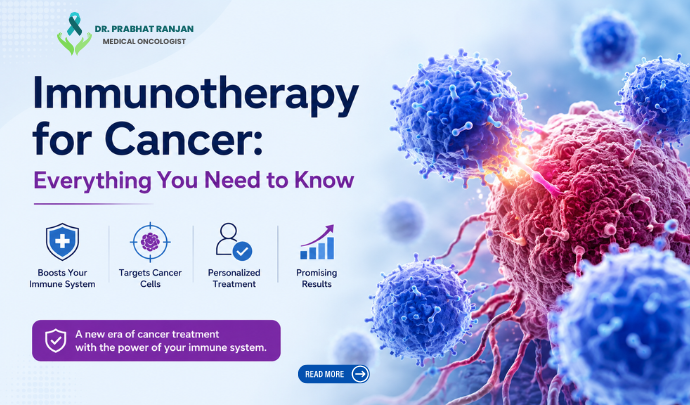
Immunotherapy does not attack cancer cells directly the way chemotherapy does. Instead, it works by activating and reprogramming your own immune system to recognise and destroy cancer cells. Think of it as training your body's defence army to fight the enemy it had previously learned to ignore.
The most commonly used immunotherapy agents are checkpoint inhibitors — drugs like pembrolizumab, nivolumab, and atezolizumab — which remove the "brakes" that cancer cells place on your immune system, allowing immune cells to attack tumours freely.
How Long Does Immunotherapy Typically Take to Work?
There is no single fixed timeline. Every patient's immune system responds differently. However, here are the general patterns observed clinically:
General response timelines:
- Early responders (4–8 weeks): Some patients begin showing signs of tumour reduction after just 2–3 cycles of immunotherapy. Scans at 6–8 weeks may already show partial response.
- Moderate responders (3–6 months): The majority of patients who respond to immunotherapy show measurable improvement between 3 and 6 months of treatment.
- Delayed responders (6–12 months): A significant subset of patients — particularly those with certain cancer types — show response only after 6 or more months of consistent treatment.
- Pseudoprogression: In some cases, tumours may appear to grow initially on scans before they begin to shrink. This phenomenon, called pseudoprogression, occurs because immune cells flood the tumour site, temporarily making it appear larger. It is not treatment failure — it is actually a sign the immune system is responding.
As the best oncologist in Greater Noida, Dr. Prabhat Ranjan emphasises to every patient that stopping immunotherapy prematurely — especially during pseudoprogression — is one of the most common and most avoidable mistakes in cancer treatment.
Factors That Affect How Quickly Immunotherapy Works
Several individual factors influence how fast — or slow — a patient responds:
Key factors include:
- Type and stage of cancer — Some cancers like melanoma and lung cancer respond faster to immunotherapy than others like pancreatic cancer
- PD-L1 expression levels — Higher PD-L1 expression in the tumour generally correlates with faster and better response
- Tumour mutational burden (TMB) — Cancers with higher mutation burden tend to respond more robustly to immunotherapy
- Overall immune system health — A stronger baseline immune function supports faster activation
- Previous treatments — Patients who have had multiple lines of chemotherapy may have a more suppressed immune system, affecting response speed
- Autoimmune conditions — Pre-existing autoimmune disorders can both accelerate and complicate immune responses
- Lifestyle and nutrition — Gut microbiome health, nutrition, and physical activity are increasingly linked to immunotherapy outcomes
How Is Response to Immunotherapy Measured?
Your oncologist will use a combination of tools to track how well immunotherapy is working:
Monitoring tools used:
- CT scans or PET-CT scans — Typically performed every 2–3 months to assess tumour size and spread
- Blood tests — Complete blood count, LFT, KFT, and tumour markers monitored regularly
- Clinical assessment — Symptom improvement, weight, performance status, and quality of life
- iRECIST criteria — A specialised imaging response criteria designed specifically for immunotherapy that accounts for pseudoprogression
Dr. Prabhat Ranjan, recognised as the best oncologist in Greater Noida, uses a comprehensive monitoring approach tailored to each patient's cancer type, treatment regimen, and individual health profile — ensuring that no sign of response or progression goes unnoticed.
How Long Does Immunotherapy Treatment Continue?
This varies based on the cancer type, treatment protocol, and response:
- For most solid tumours, immunotherapy is administered every 2, 3, or 4 weeks depending on the drug
- Treatment typically continues for 1–2 years in responding patients, after which the oncologist may recommend a treatment break with close monitoring
- In some cases — particularly where complete remission is achieved — immunotherapy may be stopped and the patient monitored for durable response
- If cancer returns after stopping, immunotherapy can often be restarted successfully
Conclusion
Immunotherapy is one of the most powerful advances in cancer medicine in recent decades — but it demands patience, consistency, and trust in the process. Unlike chemotherapy, which shows results relatively quickly, immunotherapy works by training your immune system — a process that takes time but can deliver results that are remarkably durable.
Dr. Prabhat Ranjan, widely trusted as the best oncologist in Greater Noida, practises at IOCI, Fortis Hospital, Greater Noida, and brings deep expertise in immunotherapy, targeted therapy, and personalised cancer care. He believes that an informed patient is an empowered patient — and that understanding your treatment is just as important as receiving it.
FAQs
Q1. After how many cycles will immunotherapy show results?
Most patients see early results after 2–4 cycles. Some may take 3–6 months depending on cancer type and immune response.
Q2. What if my tumour looks bigger on the first scan?
It could be pseudoprogression — a temporary swelling caused by immune cell activity. Your oncologist will confirm whether it's true progression or a response.
Q3. Can immunotherapy stop working after initially responding?
Yes. This is called acquired resistance. Your doctor may then combine it with other therapies or switch to an alternative approach.
Q4. Does immunotherapy work better for certain cancers?
Yes. Melanoma, lung cancer, and bladder cancer with high PD-L1 expression tend to respond faster and better to immunotherapy.
Q5. Is immunotherapy given lifelong?
No. Most patients receive it for 1–2 years. After that, the doctor decides whether to continue, pause, or stop based on your response.

.png)

.png)



.png)



.png)



.png)
.png)
.png)

.png)
.png)
.png)
.png)
.png)
.png)
.png)
.png)
.png)
.png)
.png)
.png)
.png)


.png)
.png)
.png)