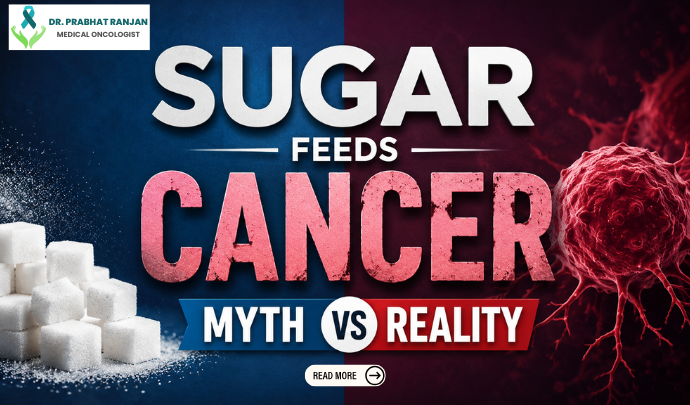
Sugar Feeds Cancer
Few health claims spread as fast or cause as much anxiety as the idea that "sugar feeds cancer." Patients frequently walk into consultations having already eliminated all sugar from their diets, convinced that even a spoonful could accelerate their disease. As the best oncologist in Greater Noida, Dr. Prabhat Ranjan regularly addresses this myth, helping patients separate scientific fact from oversimplified internet claims.
Where Did This Myth Come From?
The claim traces back to a real scientific phenomenon known as the Warburg Effect, discovered nearly a century ago. Researchers observed that cancer cells consume glucose (sugar) at a much higher rate than normal cells to fuel their rapid growth. Somewhere along the way, this legitimate scientific observation got oversimplified into "sugar causes cancer to grow faster," a claim that isn't quite accurate.
The Reality Behind the Warburg Effect
While it's true that cancer cells use more glucose than healthy cells, this doesn't mean that eating sugar directly "feeds" or accelerates tumor growth in a meaningful way. Every cell in the body — cancerous or not — relies on glucose for energy. The best oncologist in Greater Noida clarifies that simply avoiding sugar does not starve cancer cells, because the body converts other nutrients, including proteins and fats, into glucose through natural metabolic processes.
Why Cutting Out All Sugar Won't "Starve" Cancer
The body is remarkably efficient at maintaining blood glucose levels through a process called gluconeogenesis, where the liver produces glucose from non-carbohydrate sources when needed. This means that even with zero dietary sugar intake, the body will still supply glucose to all cells, including cancer cells. Extreme sugar elimination, therefore, doesn't achieve the "starvation" effect many patients hope for — and can sometimes lead to unnecessary nutritional deficiencies.
What Actually Matters: Sugar and Cancer Risk
While sugar itself doesn't directly feed tumors, excessive sugar consumption is still linked to cancer risk — but indirectly. The best oncologist in Greater Noida points to these real, evidence-backed connections:
1. Obesity Link
High sugar intake contributes to obesity, which is a well-established risk factor for several cancers, including breast, colorectal, and endometrial cancer.
2. Insulin Resistance
Chronic high sugar consumption can lead to insulin resistance, which has been associated with increased cancer risk and poorer outcomes in some cancer types.
3. Inflammation
Excessive sugar intake can contribute to chronic inflammation, a factor linked to cancer development and progression over time.
What Patients Should Actually Focus On
Rather than eliminating sugar out of fear, the best oncologist in Greater Noida recommends a more balanced, evidence-based approach:
- Moderate sugar intake rather than complete elimination
- Balanced nutrition with adequate protein, healthy fats, and complex carbohydrates
- Weight management to reduce obesity-related cancer risk
- Regular physical activity to support metabolic health
- Avoiding processed and refined sugar-heavy foods, which contribute more to inflammation than natural sugars found in fruits
The Danger of Extreme Diet Restrictions
One of the biggest concerns with the "sugar feeds cancer" myth is that it often leads patients toward extremely restrictive diets during treatment, when their bodies actually need adequate nutrition to withstand chemotherapy, radiation, or surgery. Malnutrition during cancer treatment can weaken the immune system and negatively impact recovery. This is why the best oncologist in Greater Noida strongly advises against drastic dietary changes without professional guidance.
What Supports Cancer Treatment Outcomes?
Instead of chasing sugar elimination, patients are better served focusing on factors with actual clinical evidence:
- Maintaining adequate caloric and protein intake during treatment
- Following a balanced diet rich in whole foods
- Staying physically active as tolerated
- Managing stress and prioritizing sleep
- Working closely with an oncologist and nutritionist for personalized dietary guidance
Should Cancer Patients Avoid Sugar Completely?
Not necessarily. While reducing excessive sugar intake is a reasonable general health practice, complete elimination is neither necessary nor beneficial, and can sometimes do more harm than good during treatment. The best oncologist in Greater Noida emphasizes personalized nutrition plans over blanket restrictions based on internet myths.
Conclusion
The "sugar feeds cancer" claim contains a kernel of scientific truth but has been distorted into an oversimplified and often harmful dietary myth. Cancer cells do use more glucose, but eliminating sugar doesn't starve tumors, and extreme restriction can compromise overall health during treatment. Dr. Prabhat Ranjan, recognized as the best oncologist in Greater Noida, encourages patients to focus on balanced nutrition and evidence-based lifestyle choices rather than fear-driven dietary extremes.
FAQs
Q1. Does eating sugar make cancer grow faster? No, current scientific evidence does not support the idea that dietary sugar directly accelerates tumor growth. All cells, including healthy ones, require glucose for energy.
Q2. Should cancer patients completely avoid sugar? No, complete elimination isn't necessary and can lead to nutritional deficiencies. Moderation and balanced nutrition are generally recommended instead.
Q3. Is there any real connection between sugar and cancer? Yes, indirectly. Excessive sugar intake contributes to obesity, insulin resistance, and inflammation, all of which are linked to increased cancer risk.
Q4. What diet is actually recommended during cancer treatment? A balanced diet with adequate protein, healthy fats, and whole foods, tailored to individual needs, is generally recommended rather than extreme restrictions.


.png)

.png)

.png)


.png)
.png)
.png)
.png)
.png)
.png)
.png)
.png)
.png)
.png)
.png)
.png)
.png)
.png)
.png)
.png)
.png)
.png)
.png)
.png)